As railway networks grow — with new metro lines, sleeper coaches, and export-oriented rolling stock — the demand for high-safety compliance is skyrocketing. For material suppliers and manufacturers serving this market, achieving HL3 certification under EN 45545-2 is becoming non-negotiable. But what does HL3 certification really entail — and how can you ensure a smooth, audit-ready path with minimal delays, costs, or compliance risks?
This guide walks you through why HL3 matters, what the certification process involves, and how working with a reliable fire-testing partner can make certification predictable and effective.
🔥 Why HL3 Certification Matters
EN 45545-2 defines fire-safety requirements for materials and components used in railway vehicles. Based on the vehicle’s operation and design categories, a “Hazard Level” — HL1, HL2, or HL3 — is assigned. HL3 is the highest level, reserved for high-risk applications such as sleeper coaches, double-deck trains, metro systems, or routes involving long tunnels or limited evacuation access. pmpgroup.org+2Motis Fire Testing Instrumentation+2
When materials are certified for HL3, it means they have passed the most stringent fire-reaction tests and are suitable for the most demanding railway applications. For suppliers, this provides a powerful compliance credential — often a gating requirement for tenders, audits, and export-oriented contracts. HL3 certification isn’t just regulatory — it’s strategic.
🔎 What HL3 Testing Covers: Key Parameters & Test Methods
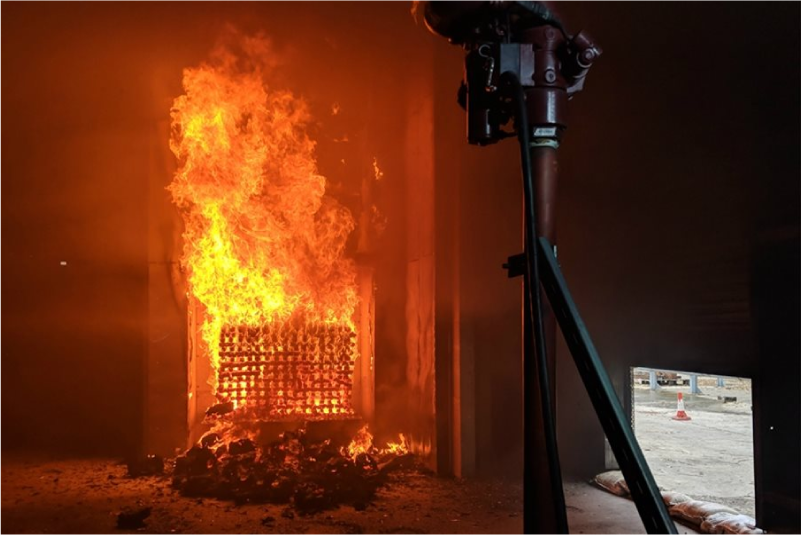
Materials under EN 45545-2 must meet strict criteria across multiple dimensions: flame spread, heat release, smoke emission, and toxic gas generation. Samaro+2Motis Fire Testing Instrumentation+2
Important tests and parameters include:
- Heat Release Rate & Fire Growth — Typically measured using a cone calorimeter (e.g. ISO 5660-1), this assesses how much heat a material releases under fire and how rapidly it contributes to flame and fire spread. Measurlabs+1
- Smoke Density & Toxicity — Tests (e.g. ISO 5659-2) evaluate the density of smoke produced and the toxicity of combustion gases — vital for passenger safety under fire conditions. Samaro+1
- Ignitability & Flame Spread (Small Flame Test) — (e.g. ISO 11925-2 or equivalent) checks how easily the material ignites and how quickly flame spreads along or across it. Measurlabs+1
Depending on the material’s application (interior panel, cable insulation, seat shell, flooring, electrical components, etc.), EN 45545-2 assigns a “Requirement Set” (R-class, e.g. R1, R22, etc.) that determines which tests apply and what performance thresholds must be met. Asahi Kasei Engineering Plastics+1
A material that passes all required tests under HL3’s thresholds becomes certified — and becomes eligible for use in the most safety-sensitive railway and metro applications.
✅ Common Challenges — And How Suppliers Trip Up
Even manufacturers with technically good materials sometimes face delays or failures in certification — not because the material is faulty, but because of common procedural oversights.
Typical pitfalls include:
- Wrong Sample Variant or Thickness: The sample tested must accurately represent the production material in composition, thickness, and finish — even small deviations cause retests.
- Incorrect Application of Requirement Set (R-class): Misclassification of material use (interior vs exterior, furniture vs electrical, etc.) leads to invalid test results or non-compliance.
- Incomplete or Non-Audit-Ready Documentation: Test reports that don’t map results clearly to production items or specification variants often get rejected in audits.
- Fragmented Testing and Multiple Labs: Using different or non-accredited labs for different tests increases risk of misalignment and audit rejection.
These hurdles often result in multiple retests, delays in supply chains, cost overruns, and lost business opportunities.
🤝 How a Trusted Fire Testing Lab Makes the Difference
Partnering with an experienced, fully equipped, accredited fire-testing lab is critical to guard against these risks and ensure a smooth HL3 certification journey. Here’s what a reliable lab should provide:
- End-to-end Testing Coverage: All HL3-relevant tests (heat release, smoke & toxicity, flame spread, etc.) under one roof.
- Pre-Assessment & Correct R-class Mapping: Guidance on which requirement set applies to your material’s use case.
- Sample Guidance & Preparation Support: Clear instructions on sample variant, thickness, finish, and quantity so your test reflects real-world production.
- Audit-Ready Reports & Documentation: Reports that link test results to production specifications — acceptable to OEMs, rail authorities, and export clients.
- Fast Turnaround & Competitive Cost: Speedy delivery of test results without compromising accuracy, and pricing that makes HL3 compliance viable even for mid-size suppliers.
By addressing these factors proactively, you reduce the chances of retesting, audit rejection, and compliance delays — enabling faster time-to-market and better competitiveness.
📈 Strategic Advantages of HL3 Certification
For suppliers and manufacturers, HL3 certification delivers several strategic benefits:
- Access to High-End Projects: Sleeper coaches, metro trains, tunnel-heavy routes, and export contracts often mandate HL3-compliant materials.
- Competitive Differentiation: HL3 certification serves as a powerful differentiator — signaling reliability and safety compliance to OEMs and clients.
- Reduced Compliance Risk: With audit-ready documentation, many of the usual delays, retesting cycles, and rejection risks are eliminated.
- Market & Export Readiness: HL3 compliance aligns with global railway fire-safety standards — enabling suppliers to bid for international contracts or supply to modern metro/rail systems.
In effect, HL3 certification is not just regulatory compliance — it becomes a competitive asset and a proof of quality.
🔧 How to Get Started: HL3 Compliance Step-by-Step
- Classify Your Material: Determine where and how the material will be used — interior/exterior, structural/furniture/electrical etc.
- Identify Applicable R-Requirement Set: Map to the correct requirement group (R1–R26) based on the application.
- Prepare Accurate Production-Representative Samples: Ensure thickness, variant, finish exactly match production.
- Send Samples to Accredited Fire-Testing Lab with Full Test Scope: Include all necessary tests for HL3 (heat release, smoke & toxicity, ignitability, etc.) under EN 45545-2.
- Receive Audit-Ready Documentation: Ensure the lab provides classification report mapping test results to your production specs.
- Use HL3-Certified Materials in Your Projects: With certification in hand, you can confidently supply to tenders, rail OEMs, metro projects, or export clients.